This upcoming week, September 22–28, marks International Week of Deaf People, a global celebration led by the World Federation of the Deaf (WFD) to spark awareness, action, and pride in Deaf culture. Monday’s theme, Deaf-led alliances in collaboration with organizations, is one I hold close to my heart. Real progress happens when Deaf professionals lead the way and allies step up in true partnership.
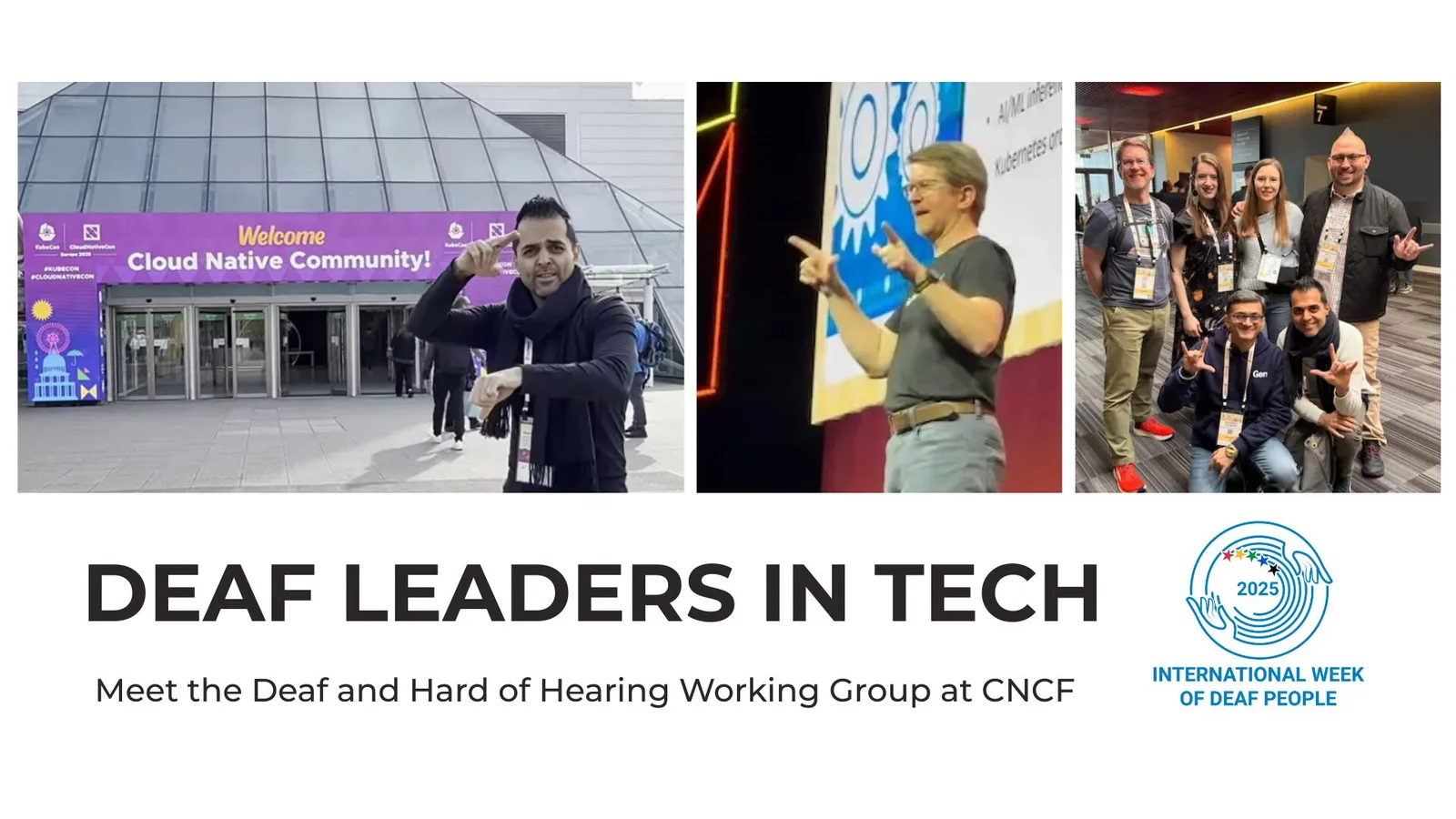
And what better time to share a story that brings this theme to life? Let me introduce you to the Deaf and Hard of Hearing Working Group (DHHWG) at the Cloud Native Computing Foundation (CNCF). Earlier this year, at KubeCon London 2025, we witnessed history … a solo Deaf keynote speaker took the stage before more than 12,000 attendees, spotlighting not only cloud native technology, but also the power of representation, access, and allyship in action.
What is KubeCon and Kubernetes?
If you’re not already familiar, KubeCon is the flagship conference of the Cloud Native Computing Foundation (CNCF). As a part of the Linux Foundation, CNCF was founded in 2015 to serve as the home for open source technologies that make software faster, more flexible, and easier to scale.
So where does the “Kube” in KubeCon come from? It’s short for Kubernetes, an open source container orchestrator that helps automate how software is deployed and managed. The easiest way I explain it to people outside tech is this: think of Kubernetes as the operating system for a data center. It’s the framework that lets developers build, run, and scale apps anywhere, reliably and at speed.
KubeCon + CloudNativeCon is about more than just the tech. Every year, it brings together thousands of adopters and technologists from open source and cloud native communities all around the world. It’s a hub for collaboration, learning, and connection.
Innovation doesn’t happen in isolation. It thrives on diversity and authenticity. That’s why this story matters so much and why it ties perfectly into International Week of Deaf People.
Deaf Representation, Sign Language, and AI
Think about the last conference you attended. The keynote usually follows a familiar script: the lights dim, the projector hums to life, the audience quiets, and the speaker takes the microphone.
But this time it was different. This time, the keynote began with raised hands in the spotlight, signing.
Meet Rob Koch, Senior Principal at Slalom Build and the co-chair of the Deaf and Hard of Hearing Working Group (DHHWG) at CNCF. Rob didn't just deliver a presentation, he transformed how we think about accessibility in tech.
His talk, Empowering Accessibility Through Kubernetes: The Future of Real-Time Sign Language Interpretation showcased how Kubernetes is well positioned to support complex AI workloads and optimize cluster resources for video and language processing.
One of my favorite quotes from his keynote was,
“... proves that authenticity matters when you create training models. In other words, whoever knows the language or models knows best what works and what doesn’t work.”
- Rob Koch
The key takeaway here is simple, projects involving sign language should always be led by Deaf native signers and Deaf professionals.
As technology advances, sign language rights must enter the digital space as well. The World Federation of the Deaf (WFD) captures it perfectly with their motto: “Nothing about us without us.” True progress comes when Deaf people lead, and allies stand alongside them.
These days, AI is everywhere. And while I’ll always advocate for human interpreters in education, healthcare, and professional settings, I can’t help but imagine the potential of AI for everyday interactions that are often taken for granted … ordering a coffee, mailing a package at the post office, or letting someone at the gym know you’ve got a few sets left. As Rob reminded us in his keynote, communication barriers still exclude millions from fully participating in everyday life.
Interpreters, Captioning, and Keynotes
To build off those everyday barriers faced by the Deaf and hard of hearing community, here’s a challenge for you: give Rob’s keynote a quick watch, even just a minute. The voice you hear is an interpreter interpreting Rob’s American Sign Language (ASL) into English. Now ask yourself: without that interpreter, how much of his message could you have understood? Probably not much.
That’s the point. Deaf and hard of hearing attendees can’t access your conference materials without sign language interpreters, live captioning, or other accessibility assets. Equal access means ensuring your event is open to everyone and making it clear from the start by advertising those services on your website. Accessibility should never be a hidden detail.
Now, shift perspectives for a moment. Imagine you’re a Deaf or hard of hearing attendee. How often do you get to witness a transformative keynote delivered in your own language by a leader who reflects your community? That’s rare, and it’s exactly why I’d fly across the pond to attend a conference like this.
Representation is powerful because it inspires. It allows us to see a reflection of ourselves and the potential for more: more collaboration, more innovation, more advancement. Even more, it opens doors for future generations of Deaf and hard of hearing professionals while showing colleagues our capabilities.
When organizations like CNCF diversify their keynote lineups, they’re not checking a box, they’re sparking a catalyst for change.
Inclusive Events at International Conferences
Why do people attend conferences in the age of webinars? It’s for networking and genuine in-person connections. KubeCon London 2025 centered community by featuring panel discussions, conversations, and even a sign language crash course! If you are looking for ways to make your own conference more inclusive, these are some great ideas to encourage engagement.
Sign Language Crash Course
Some of the most memorable conference moments are interactive, and the sign language crash course was no exception! Milad Vafaeifard, a Deaf lead software engineer and founder of Sign Language Tech, co-led the session, introducing attendees to the basics of both British Sign Language (BSL) and American Sign Language (ASL).
Fun fact: even though the UK and US share English, BSL and ASL are completely different languages. This crash course was a great way to debunk the common misconception that sign language is universal.
A special thanks to Milad for sharing his experience and allowing me to interview him for this blog! Watch Milad’s vlog of his KubeCon experience below.
Panel Discussion: Why Allyship Matters
Why Allyship Matters and Your Role in Creating a More Diverse Cloud Native Community was a truly unique panel bringing together a variety of languages and perspectives: spoken English, British Sign Language (BSL), and American Sign Language (ASL), featuring both Deaf and hard of hearing panelists. Discussions ranged from real-life examples of allyship in action to practical tips for advocating more accessible and inclusive spaces.
Interested in becoming an ally, or are you Deaf or hard of hearing, exploring a career in tech? Join the Deaf and Hard of Hearing Working Group (DHHWG), it's open to everyone! In a world where we’re building the future, every voice matters, whether spoken, signed, or coded. Shouldn’t everyone have a hand in shaping it?
CNCF’s KubeCon reminds us that small actions can have a big impact. Every inclusive conversation creates ripples that extend far beyond conference walls to friends, families, and workplaces alike.
International Week of Deaf People
As we celebrate International Week of Deaf People, I invite you to amplify the voices of Deaf leaders in their fields. And don’t stop at a week; think ahead to 2026: How can you collaborate with the Deaf community on a blog, social media, or as a keynote speaker? What groups could you join, like the Deaf and Hard of Hearing Working Group (DHHWG)? Or maybe it starts with something simple, like providing accessibility services to ensure Deaf and hard of hearing individuals feel welcome at your online and in-person events
If the world of accessibility is relatively new to you, it can be hard to know where to start. Send us a quick email at ICS to learn how we can help you create accessible, welcoming spaces for everyone.