When Bad Bunny took the stage at Super Bowl LX in February 2026, history was made. Millions of Americans whose first language was English found themselves lost in a sea of Spanish lyrics. Even viewers with a few years of conversational Spanish barely caught a phrase of the performance.
That experience was intentional, and it offers a glimpse of understanding what life is like for the estimated 25 million people in the U.S. who have Limited English Proficiency (LEP) (MACPAC, 2024). Unlike a three-minute song, LEP individuals navigate this challenge every single day across healthcare, education, and social services. Arguably, a bit more consequential than following along with Yo Perreo Sola.
If you made the decision to include spoken language interpreting at your event to bridge the gap between English speakers and individuals who speak other languages or have Limited English Proficiency (LEP), this article is for you.
Spoken Language Interpretation
Some steps in setting up spoken language interpreting services feel fairly intuitive. Most organizations do a great job working with their audiences and communities to identify which languages need to be interpreted. Then follow up to ensure essential written materials will be translated as well.
Setup and equipment are equally important and this is often where things get tricky, because no two venues are alike. Any event with sound involves a whole system of technology to get that sound to your audience: microphones, speakers, mixing boards, and more.
The way sound reaches your interpreting team is often overlooked. However, it is one of the highest-impact decisions for ensuring your audience receives the best possible experience. It all starts with understanding sound clarity and what it means for your interpreters.
Direct vs. Indirect Audio
Not all sound reaches our ears in the same way. Some sound comes directly from the source. Other sounds arrive after bouncing around the room. This difference affects clarity.
- Direct audio is sound that goes straight from the source to your ears. It arrives first and is the cleanest sound you can hear.
- Reflected or indirect audio is sound that hits walls, floors, and ceilings and then comes back to your ears. It arrives later than direct sound.
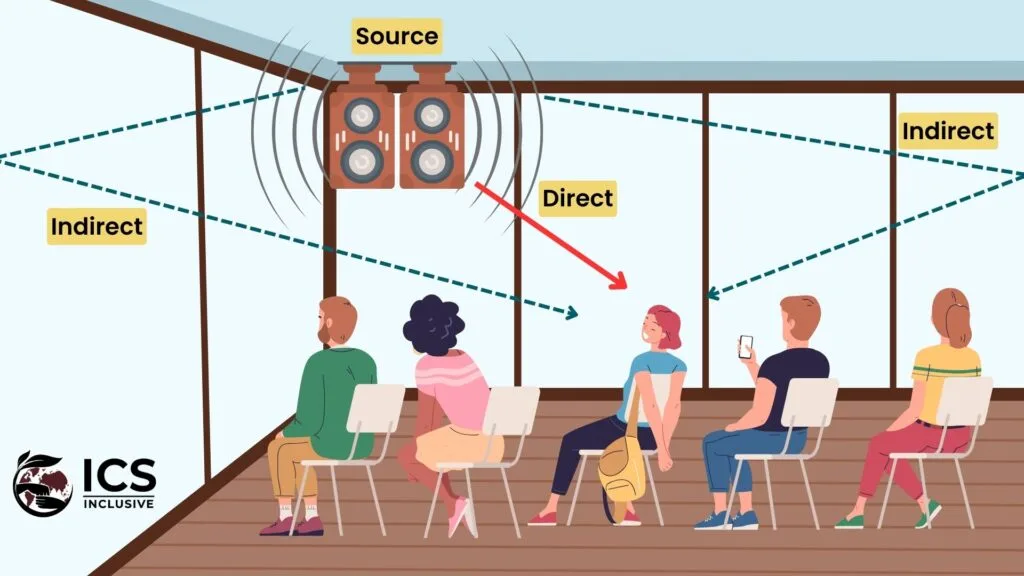
A diagram of people in a room with sound waves from speakers, showing direct and indirect sound paths.
With those two definitions in mind, we can better appreciate why direct audio is one of the most impactful tools you can provide your interpreting team. Like any professional, giving interpreters the best possible resources to do their job is simply good business because it sets them up for success, which in turn sets your audience up for success.
What many people don't realize is that interpreting consistently ranks among the most cognitively demanding professions. The mental load is significant, and sound quality plays a direct role in how heavy that load becomes. (Hao Yan, et al., 2024)
What Happens Without Direct Audio?
When interpreters don't have access to a direct audio feed, they're left to pick up speech from the general room sound, just like everyone else in the audience. And general room sound means interference.
Without a designated listening position or a clean feed, interpreters have to work harder just to hear before they can even begin to interpret. That extra effort by straining to catch words, filtering out noise, piecing together meaning, all pile onto an already demanding cognitive process.
The result is increased mental fatigue, reduced accuracy, and a lower quality experience for the audience members who depend on that interpretation most.
Collaboration with AV and Tech Teams
Interpreters need the clearest possible sound to do what they do best: bridge the gap between speakers and audience, and deliver the message accurately and effectively.
So how can event organizers make that happen? Coordinating with your AV and tech teams should be on every event checklist. That means getting ahead of interpreter needs before the event: confirming that a direct audio feed can be provided, working out the technical details in advance, and scheduling a tech check, ideally a few days prior, or at minimum earlier on the day of the event.
If direct audio isn't possible, a designated seating area for interpreters is the next best option, somewhere they can hear the speakers as clearly as possible with minimal interference.
Interpreting Equipment
When collaborating with your AV and tech teams, sharing information about the venue setup and planned equipment is part of the process. There are several types of spoken language interpreting equipment. Here's a breakdown of the most common options.
Microphones and Headsets
High-fidelity microphones for clear audio input, paired with comfortable headsets for both interpreters and audience members. This is the most accessible and affordable interpreting equipment available and the type ICS provides nationwide.
How does it work? The interpreter wears a headset receiving direct audio from the speaker's microphone, while also wearing a microphone of their own. Audience members wear a separate headset that picks up direct audio from the interpreter's microphone. This setup allows audience members to fully experience all the visual elements of an event while accessing real-time interpreted audio through their headset.
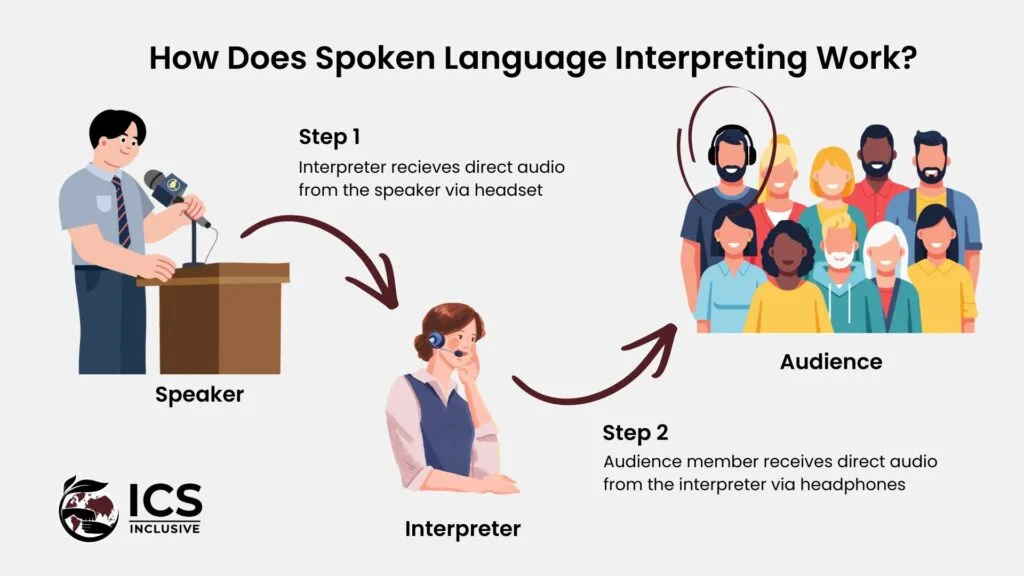
The flowchart illustrates the process of spoken language interpreting, showing a speaker, interpreter, and audience. How Does Spoken Language Interpreting Work? Step 1: Interpreter receives direct audio from the speaker via headset. Step 2: Audience member receives direct audio from the interpreter via headphones.
For higher-profile events, especially those involving multiple languages, also consider:
Interpreter Booths
Soundproof booths (fixed or portable) that isolate interpreters from background noise, supporting greater focus and audio clarity.
Interpreter Consoles
Specialized units that allow interpreters to manage audio input, switch between channels, and control volume, giving them more control over their listening environment.
Checklists for Spoken Language Interpreting at Your Event
Planning an accessible event means thinking ahead, and when it comes to spoken language interpreting, the details do matter. What better way to wrap up this blog than with a checklist?
Language Planning Checklist
- Identify which languages will be interpreted based on your audience and community
- Request quotes from language accessibility providers as early as possible
- Confirm the number of interpreters needed for a language
- Discuss interpreting needs: consecutive vs simultaneous
- Confirm equipment rental requirements (e.g. microphone and headsets)
- Inquire about translation services for essential written materials
- Schedule a meeting to discuss your event details and sign a service agreement
Venue & AV Coordination Checklist
- Inform AV and tech teams early that spoken language interpreting services will be provided, and collaboration will be needed
- Share interpreting equipment details with the AV and tech teams and confirm that direct audio is possible and all equipment is compatible
- Request a tech check a few days before the event, or earlier on the day of the event
Week of the Event Checklist
- Brief interpreters on the event agenda, speaker names, specialized terminology, and provide any preparation materials needed
- Confirm that the interpreter station or seating is set up and accessible
- Confirm the AV team has scheduled a sound check that includes the interpreter equipment
- Designate a point of contact for interpreters to flag any audio issues in real time
Sources:
Hao Yan, et al. “Assessing mental demand in consecutive interpreting: Insights from an fNIRS study.” Acta Psychologica, Volume 243, 2024. https://doi.org/10.1016/j.actpsy.2024.104132
Medicaid and CHIP Payment and Access Commission (MACPAC). “Enrollment and Access Barriers for People with Limited English Proficiency.” 2024. https://www.macpac.gov/publication/enrollment-and-access-barriers-for-people-with-limited-english-proficiency/.
Misigo, Steven. “Direct Sound vs Reflected Sound Phase 1.” LinkedIn, posted 2026. https://www.linkedin.com/posts/steven-misigo-719428283_direct-sound-vs-reflected-sound-phase-1-activity-7415458361258930176-XeRX/.
Violet, David. “Interpreters need higher quality sound than ordinary listeners.” Youtube, posted 2022. https://www.youtube.com/watch?v=6GCazllBtsg