A Conference, a Tweet & a PhD
In 2016, I attended my first ever efsli conference, in Athens. That’s where I was first exposed to International Sign (IS). I wanted to learn more, but the answers I received were vague and unsatisfying. “It’s not a real language,” people said. “You can’t really learn it. Just meet Deaf people at international events and focus on iconicity.”
I wasn’t convinced.
How do you learn something that’s “not a language”?
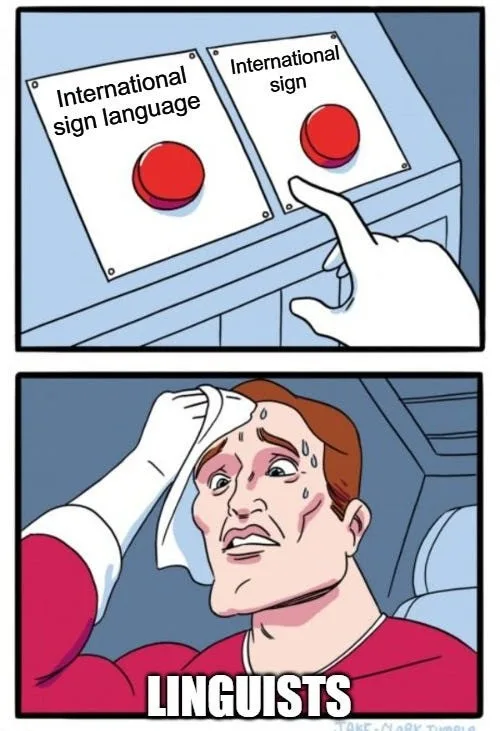
And if it’s all about iconicity, then why did I keep noticing the same signs used again and again by different people? Clearly, there was something systematic going on – some kind of vocabulary or structure.
A year later, in 2017, I came across a tweet by Professor Dr. Onno Crasborn inviting applications for a PhD research position on International Sign (IS) at Radboud University (same research project as colleague Dr. Maya de Wit - if you know, you know). The only requirements: be a sign language interpreter (any signed language) with a background in linguistics.
I applied without hesitation.
That tweet became the starting point of a journey that, years later, led to my PhD defense on Monday, August 25th, at Radboud University. That day, I officially became a Doctor.
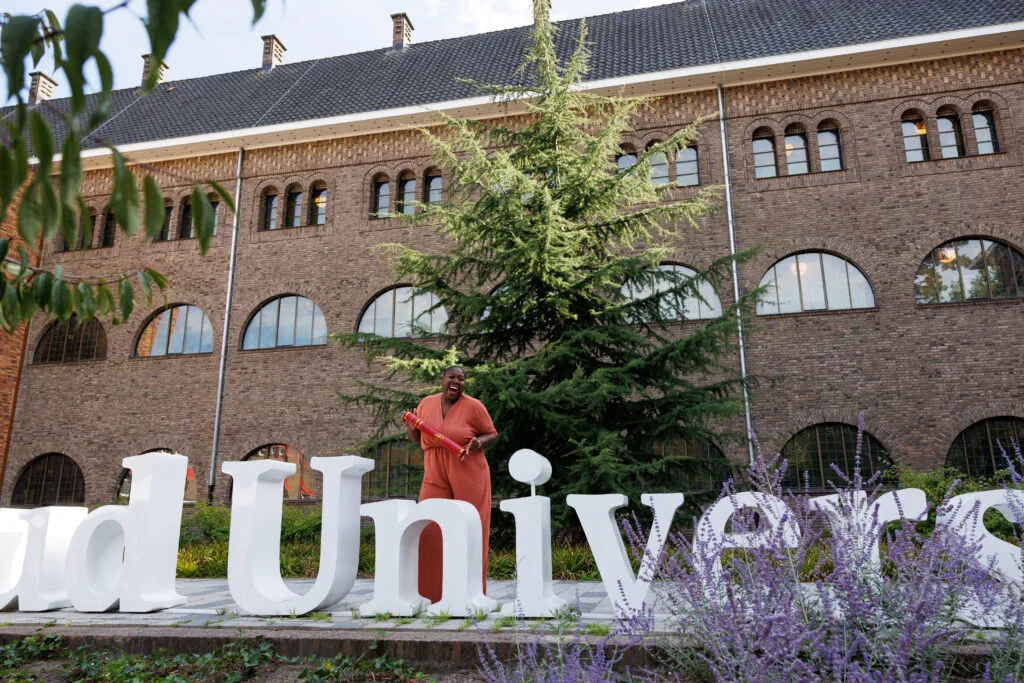
Aurélia NGG with RU letters + PhD diploma
What I Did in My PhD
My aim was simple: I wanted to highlight the specific features of International Sign (IS) used by interpreters by comparing it directly to a national sign language – here in the Netherlands, NGT (Nederlandse Gebarentaal). It’s like saying “Paris is a big city” – but compared to what? It might be big next to Buffalo, but small next to New York.

Paris, Buffalo, and New York City
In previous studies, IS produced by interpreters or Deaf presenters was often compared to different datasets, different studies. What made my PhD research different was the setup: I didn’t compare interpretations based on different source texts. Instead, I recreated real-life conference situations – like at efsli events – where IS and local sign language (SL) interpreters work from the same source (I had 3 events with 6 lectures in total; 4 NGT interpreters and 4 IS interpreters). That way, I could compare apples to apples.
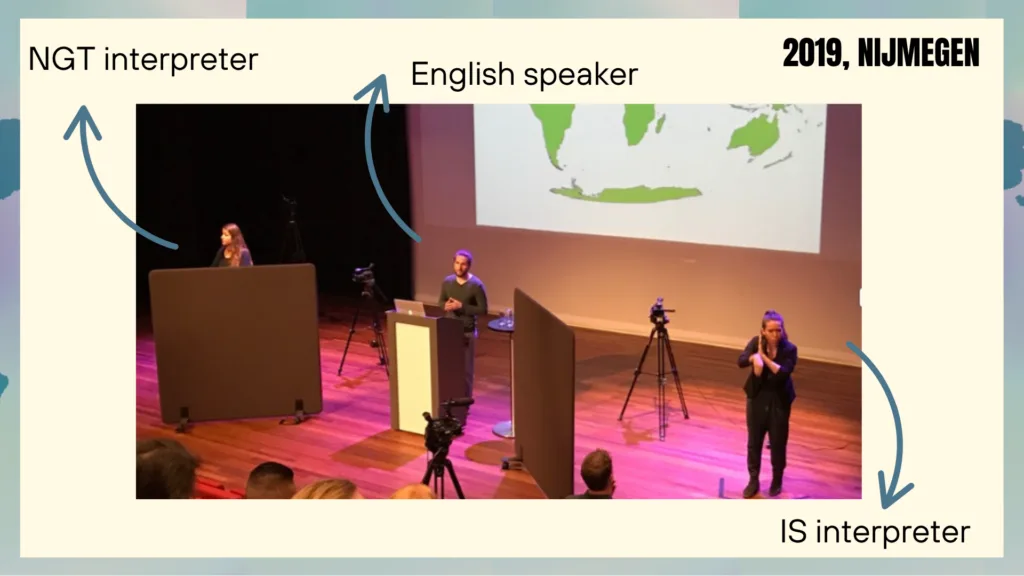
Data collection setting for chapters 3 and 4 of my PhD dissertation
For one study, in the audience, we brought in Deaf participants from several regions of the world: from China (in 2019 – just before COVID hit, lucky timing!), as well as from Belgium (both Wallonia and Flanders), and of course, from the Netherlands.
I used the software ELAN to annotate many features: timing, pauses, handshape changes, lexical signs, depicting signs, etc. you name it. I looked at processing time, false starts, vocabulary density, and more.
Two Findings Stood Out to Me
Processing Time in IS is Not What you Think (Anymore)
Like many colleagues, I had the impression that IS interpreters took more time before starting their output – that their processing time was longer. And it’s true: in one of my datasets, the processing time for IS interpreters was indeed longer on average (2.8 seconds) than for NGT interpreters (1.8 seconds). FYI, the average processing time for American Sign Language (ASL) interpreters and spoken language interpreters ranges between 2 and 5 seconds. In my dataset, I found a processing time ranging from 1.9 to 2.6 seconds for the NGT interpreters and from 2.7 to 2.9 seconds for the IS interpreters. Here’s the twist: the difference wasn’t huge (or statistically significant as academics say in their jargon!), and it wasn’t consistent across all interpreters.
What really emerged was that processing time seemed to be more dependent on the individual interpreter than on the working language. Some people process longer before signing, regardless of the language they’re working into. Others start earlier, whether in NGT or IS.
But what surprised me even more is that NGT interpreters produced more false starts than IS interpreters. They were more likely to start signing and then abandon or revise their output. Why?
My interpretation is this: when we work into a national sign language, we have a richer, more fixed lexical base to rely on. That can be both a strength and a trap. It tempts us to start producing signs earlier, because we “know” how to say something. But that confidence can lead us to jump in before we’ve fully processed the message.
On the other hand, IS interpreters have fewer lexical anchors. They’re not reaching into a mental dictionary as much – they’re relying on processing, on creating meaning with the audience in mind. They tend to wait longer, think more, and therefore produce fewer false starts.
In a way, they’re forced to de-verbalize (as we say in French! i.e. unpack the meaning), more deeply, and that shows in the output.
Vocabulary in IS Not What you Think (Anymore)
Spoiler alert: International Sign has vocabulary.
A lot of people still think IS is mostly made up of improvised gestures and visual iconicity. But my research tells a different story.
Sure, IS has a smaller lexicon. And yes, it allows for more creativity and flexibility than national sign languages. But it does have vocabulary. That vocabulary is reused. It can be learned. Over time and within shared contexts, IS interpreters build up common resources – and they use them.
Now, IS is still very context-dependent. IS at the UN, at EUD, in Europe, in Latin America – they’re all a bit different. But even within that diversity, there’s a shared foundation.
For one of my datasets, for example, lexical items made up 60% of IS output, compared to 80% for NGT interpreters. So yes, it’s a smaller lexicon than NGT, but lexicon still forms the bulk of IS.
Then I looked at how those lexical signs are used in IS. One interesting pattern: IS interpreters often enhance signs with an extra layer of iconicity.
Example 1
Take the lexical sign [ANIMAL], which both NGT and IS interpreters used. The difference? The IS interpreter added a layer of meaning by exaggerating the iconic features – bringing out the dormant visual metaphor embedded in the sign.
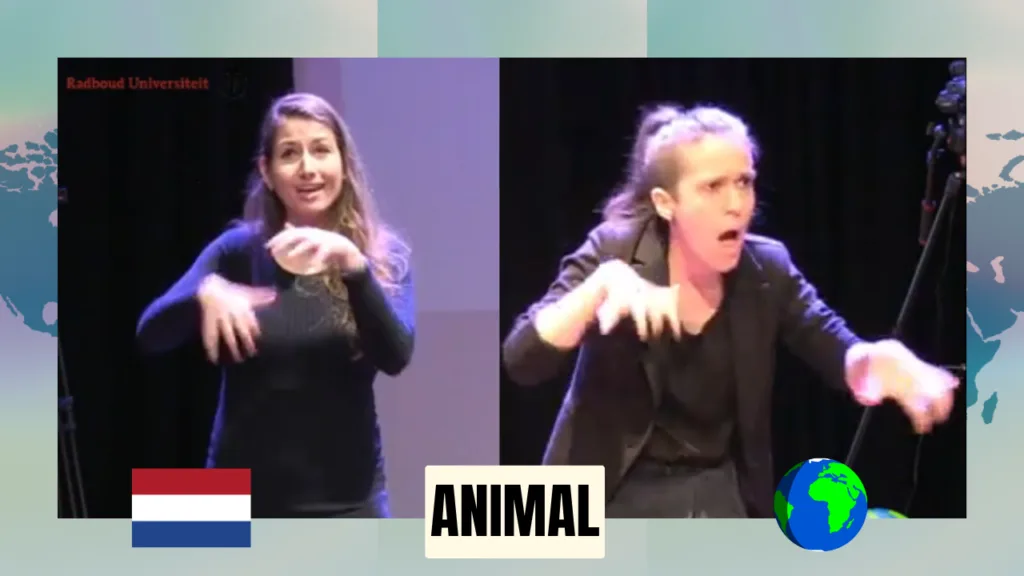
Screenshot from my PhD thesis, Chapter 4, p.128
Example 2
Take the sign [CONTINENT]. The NGT interpreter used one general sign. But the IS interpreter used distinct signs for each continent and mapped them spatially.
Here again, lexical signs aren’t just used, they’re enhanced adding an extra layer of iconicity.
The sign for AMERICA was placed to the left, ASIA to the right, and EUROPE in the middle, creating a visual, spatial representation of the world. That’s not ad hoc. That’s lexical and intentional.
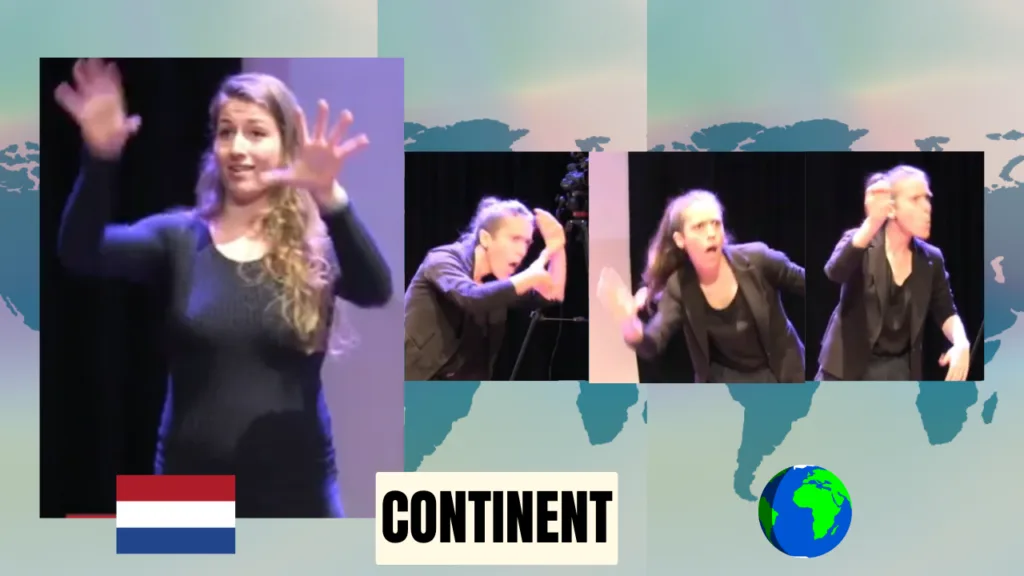
Screenshot from my PhD thesis, Chapter 4, p.127
What ASL Interpreters Can Take Away
So what does all this mean for working interpreters – especially those using ASL (American Sign Language)?
Here are a few reflections:
Take Your Time
A longer processing time isn’t a weakness. It can be a sign of deeper… processing! (and not lagging behind). If you find yourself rushing to produce signs because you “know” the terminology, consider slowing down and checking your comprehension.
Watch Your False Starts
They’re often a clue that you’re prioritising output over understanding. Notice when they happen. What triggers them? What helps you avoid them?
Embrace De-verbalization
Even in a richly lexical language like ASL, we can benefit from the mindset IS interpreters often adopt: meaning first, form second.
From Research to Practice: the Birth of The 20-20
All along my PhD journey, I found myself having conversations with colleagues across Europe and beyond. During my PhD, I had the chance and the time (!) to read research and to extract takeaways for my daily practice as an LSF interpreter. Unfortunately, research rarely reached out to interpreters. That’s when I created The 20-20, the Sign Language newsletter that brings research to practice!
Fun fact: Why “The 20-20”?_
In team interpreting, we take turns regularly. In my home context, it’s usually every 15 minutes, so we say “Let’s do 15-15”. But in international settings, I noticed many teams work in 20-minute shifts: “20-20”. That became the perfect name for a global newsletter – rooted in the rhythm of our profession and sent every 20th at 20h (Paris time)._
Each issue focuses on one practical insight from research that can support sign language interpreters globally. We talk about ethics, cognitive load, multilingual teams, AI, and of course… International Sign.
My hope is that by sharing findings like these – not in academic journals, but in accessible formats – we can raise the standard of interpreting everywhere.
Resources
If you want to go deeper:
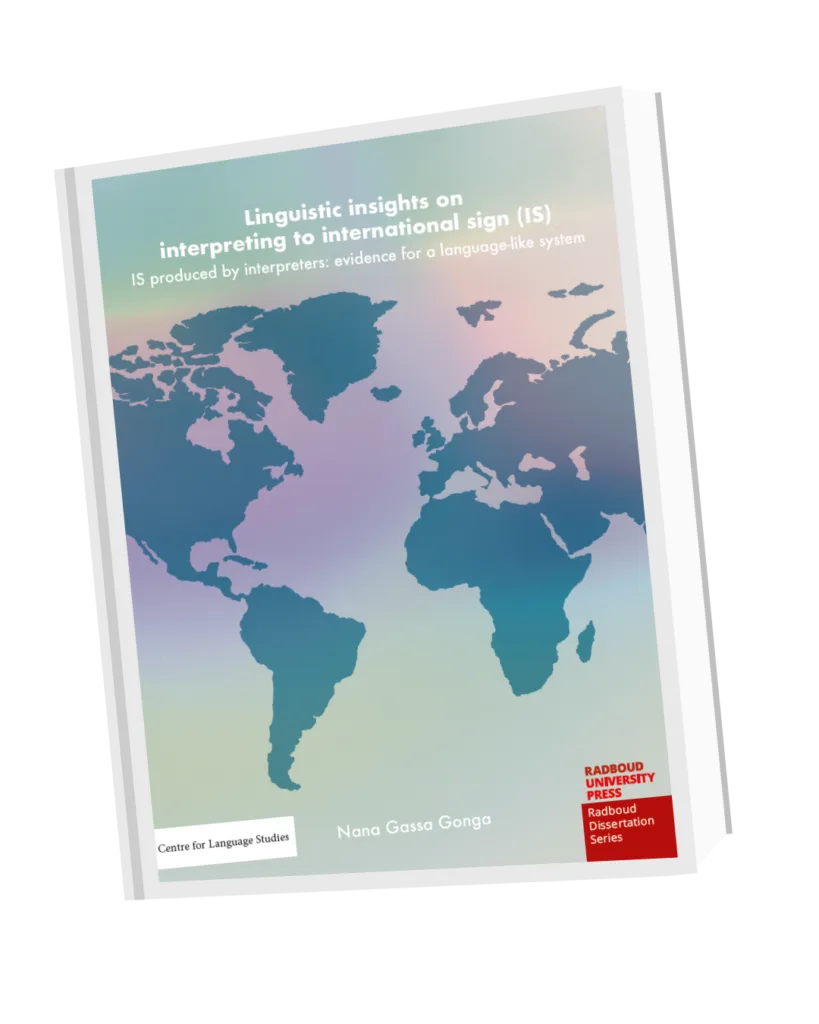
- My full PhD dissertation is freely available online via Radboud University Press
- Two issues of The 20-20 newsletter (#6 and #7) are about IS interpreting with more video examples. Subscribe and request your first free issue here: https://the2020.substack.com/
- The 2nd edition of Overseas Interpreting Winter School for sign language interpreters working across languages and cultures. Dates: from 24 to 28 August, Valencia (Spain).