When sign language interpreters graduate, we leave training with theory, techniques, ethical frameworks, supervised practice, and hopefully enough tools to begin working.
But that is exactly what it is: a beginning.
Then the profession happens.
You encounter an assignment you were never prepared for. A linguistic choice you have never had to make before. A Deaf client who challenges the way you usually work. Technology changes. Research evolves. Professional expectations shift.
Initial training gives us a foundation. A career keeps asking us to build on it.
Continuing education exists but it is not always sustainable
In the United States, sign language interpreters have access to many continuing education opportunities: conferences, workshops, webinars, and specialized training throughout the year.
But access to learning is not the same as sustainable professional development.
Training often comes with registration fees, travel costs, accommodation, and lost income while away from work. For many interpreters, especially freelancers, this makes professional development valuable but difficult to sustain regularly.
For many interpreters, the challenge is not a lack of good training opportunities. It is finding a sustainable way to keep learning over time.
Continuing education is not the same as continuous learning
This distinction matters. Many interpreters learn in bursts: a conference once a year, a workshop when finances allow, a training opportunity when schedules align.
These experiences can be excellent. We need them. But they do not always create a regular rhythm of learning. And that rhythm matters. Continuing education is valuable. Continuous learning is a habit.
Sign language interpreting is a profession that keeps evolving. Languages change. Communities change. Professional contexts change. Technologies change. And research keeps challenging and expanding what we think we know. The profession keeps moving. So should our learning.
Consistency often matters more than intensity
Professional learning works a bit like physical training. You do not build long-term strength through one intense effort every six months. You build it through regular practice. The same principle can apply to professional development.
Alongside conferences, workshops, and in-depth training, interpreters also need lower-friction ways to stay intellectually engaged with their profession. A little, regularly, can take you further than a lot, once or twice a year.
There is plenty of research. That is not the problem.
As a researcher, I spend a lot of time reading academic papers and, fortunately, I genuinely enjoy it. I am also a working sign language interpreter.
Moving between those two worlds has made me increasingly aware of the gap between the research being produced and what reaches everyday interpreting practice. There is fascinating research on sign language interpreting, signed languages, Deaf communities, cognition, linguistics, ethics, and professional practice. And interpreters are curious about it.
We ask questions constantly:
Why did that interpretation feel so difficult?
Is this something other interpreters struggle with too?
What does the research actually say about this?
The curiosity is there. The bridge is often missing.
Research can support practice if we can bring the two together
Academic research was not written for your Tuesday evening after a full day of interpreting, preparation, emails, and life. It serves important scientific purposes. It explains methods in detail. It assumes background knowledge. It often uses specialized terminology. And sometimes, it sits behind a paywall.
That does not mean research needs to be simplified beyond recognition. It means we need better ways to bring research and practice into conversation. During my PhD, I studied International Sign interpreting and compared it with national sign language interpreting. I spent an unreasonable amount of time annotating interpreters frame by frame, looking at processing time, pauses, lexical choices, depicting strategies, and more.
And then I would go back to interpreting.
Over time, I stopped only asking:
I started asking:
What does this mean for us, as interpreters?
Does this challenge something we assume about our practice?
Could this help us ask a better professional question?
Because research does not always need to give us a final answer. Sometimes its most useful role is to give us a better question.
Why I created The 20-20
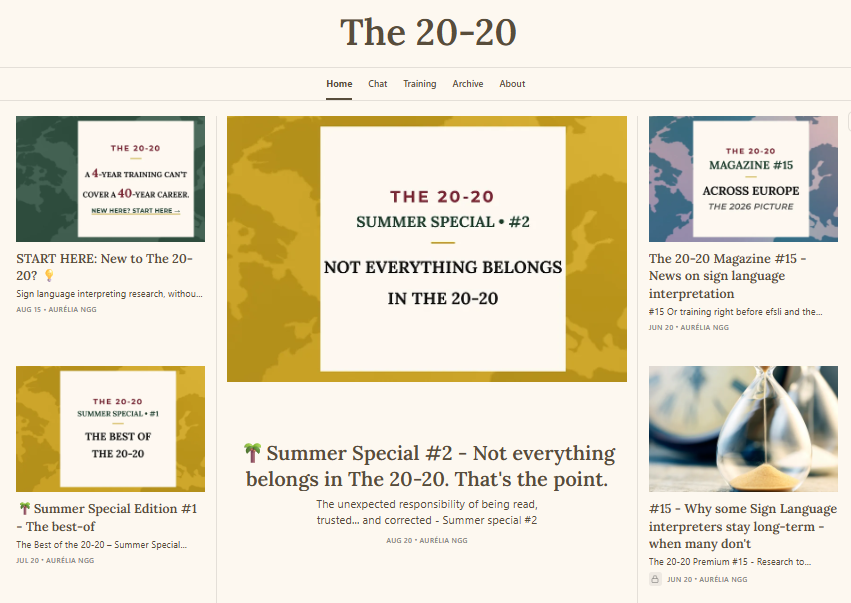
That idea became the foundation for The 20-20. The 20-20 is a research-to-practice newsletter for sign language interpreters. I created it as a lighter, more regular way for interpreters to stay connected to research and to the evolving questions of our profession.
The principle is deliberately simple:
One research paper, translated into practice.
Actionable takeaways for interpreters.
Each edition breaks down the research, looks critically at what the researchers actually found, and brings it back to the question that matters most:
What does this mean for our practice?
The goal is not to turn every interpreter into an academic researcher. And it is definitely not to pretend that one study can give us a definitive answer to a complex professional question.
The goal is to make research easier to enter — and easier to bring back to our work.
Research. Practice. Progress.
A profession that evolves needs learning that evolves too
We still need conferences, workshops, in-depth training and opportunities to learn together. But a profession that changes constantly cannot rely only on occasional, high-effort moments of development.
We also need regular ways to keep thinking, questioning, reflecting, and growing. That is the kind of continuous learning The 20-20 is designed to support.
Because a 4-year training can’t cover a 40-year career. And perhaps it was never supposed to.
We were never supposed to graduate as finished interpreters. We were supposed to become professionals capable of continuing to learn.
And if our careers can last 40 years, our learning should too.